TIME World War I: The War That Shaped Our World by The Editors of Time
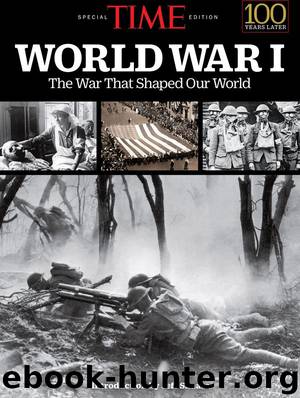
Author:The Editors of Time
Language: eng
Format: azw3
ISBN: 9781683308027
Publisher: TIME
Published: 2017-03-31T04:00:00+00:00
A 1916 French poster declares, “We’ll get ’em!”
A soldier from Britain’s Cheshire Regiment peeks out of a well-fortified trench during the Battle of the Somme.
A wounded soldier is removed from the field of battle on a wheeled stretcher at the Battle of the Somme.
Battles at Sea
Britannia ruled the waves—but the war’s one great naval clash was a draw
British ships form a line during the Battle of Jutland off the coast of Denmark in the North Sea.
World War I was in some measure born of the sea and decided by the sea. Yet although the conflict is remembered for including some of the largest and bloodiest land battles in history, it featured only a single great action in the open sea, the Battle of Jutland, on May 31–June 1, 1916.
Historians agree that one of the war’s primary drivers was the battle for maritime supremacy between the U.K. and Germany. Britain’s Royal Navy was by far the strongest military force on the seas, keeping the bloodstream of its overseas trade and colonial empire circulating—and the leaders of ascendant Germany knew it. Beginning in 1898, the two nations began to wage an aggressive nautical arms race that accelerated the Continent’s evolving dynamic of Anglo-German enmity.
The contest heated up in 1906, when Britain unveiled a radical new version of the era’s alpha weapon of the seas, the battleship. When H.M.S. Dreadnought was christened by King Edward VII on Feb. 10, 1906, it immediately made all other battleships afloat obsolete; from that day on, they were called “pre-Dreadnoughts.”
Significantly larger than any previous battleship, at 527 feet long and 82 feet wide, the Dreadnought was a far more powerful offensive weapon. Battleships are essentially floating artillery emplacements, and the Dreadnought was the first such ship to boast a main battery of ten 12-inch guns in five twin turrets—far more firepower than its rivals carried. Powered by steam turbines, it boasted a top speed of 21 knots, faster than any other war vessel on the seas. Its pioneering big guns employed electrical power, superior to human operation, for range-finding, tracking and correcting shell trajectories.
By 1914, after the rivals had expended enormous sums of treasure and time, the German navy had 17 Dreadnought-class battleships in its fleet but was still playing catch-up with the British, who had 29. When the war began, the British quickly initiated a blockade of German ports in the North Sea, and the commanders of Germany’s Hochseeflotte (High Seas Fleet), aware they were outmatched, refused to challenge their foes. But the Germans soon discovered that another relatively new craft, the Unterseeboot, or U-boat, was a potent weapon against Britain’s big ships. Floating mines, which sank the Dreadnought-class H.M.S. Audacious in October 1914, further demonstrated the Royal Navy’s vulnerabilities.
In February 1915, the Germans took a gamble: with their imports severely restricted by the tight British blockade, they announced their U-boats would begin unrestricted warfare against merchant and cruise ships carrying supplies to Britain. The gamble was tested when a U-boat brought down the Cunard Line’s
Download
This site does not store any files on its server. We only index and link to content provided by other sites. Please contact the content providers to delete copyright contents if any and email us, we'll remove relevant links or contents immediately.
| Africa | Americas |
| Arctic & Antarctica | Asia |
| Australia & Oceania | Europe |
| Middle East | Russia |
| United States | World |
| Ancient Civilizations | Military |
| Historical Study & Educational Resources |
The Radium Girls by Kate Moore(12097)
100 Deadly Skills by Clint Emerson(4975)
Rise and Kill First by Ronen Bergman(4842)
The Templars by Dan Jones(4740)
The Doomsday Machine by Daniel Ellsberg(4557)
The Rape of Nanking by Iris Chang(4267)
Killing England by Bill O'Reilly(4045)
Stalin by Stephen Kotkin(4009)
Hitler in Los Angeles by Steven J. Ross(3982)
12 Strong by Doug Stanton(3583)
Hitler's Monsters by Eric Kurlander(3389)
The Code Book by Simon Singh(3254)
Blood and Sand by Alex Von Tunzelmann(3243)
Darkest Hour by Anthony McCarten(3164)
The Art of War Visualized by Jessica Hagy(3047)
Hitler's Flying Saucers: A Guide to German Flying Discs of the Second World War by Stevens Henry(2778)
Babylon's Ark by Lawrence Anthony(2722)
Tobruk by Peter Fitzsimons(2565)
The Second World Wars by Victor Davis Hanson(2555)
